
Pathfinder E-Bike Buying Guide: How to Choose the Right Electric Bike
⚡ The Contrarian Truth: Stop Reading Spec Sheets
Here is the scene: You decide you want an e-bike. You open a few tabs, and within ten minutes, you are drowning in a sea of chrome tabs and spec sheets.
750 watts continuous. 52-volt controller. 85 Newton-meters of torque. 21700 lithium cells. Dual-piston versus quad-piston hydraulic calipers.
You sit back in your chair, rub your eyes, and think:
“Look, I just want a great bike to ride around town. Which one actually fits my life? What do I actually need to care about? Can somebody please just make this easy for me?”
Here’s the dirty little secret the e-bike industry won’t tell you: Buying the bike with the biggest numbers on paper is the fastest way to end up with an unrideable, 80-pound garage ornament.
A massive off-road battery sounds impressive until you realize you have to lug an 85-pound frame up two flights of apartment stairs. A 1,000-watt speed demon looks exciting until you find out it’s banned on your local city greenway.
You don’t need an electrical engineering degree to buy an e-bike. You just need to answer three simple questions:
- What daily job am I hiring this machine to do? (Your Desires)
- What happens when things go wrong? (Your Concerns: Theft, breaks, batteries)
- What are the real-world rules of the road? (Your Expectations: Laws, range, maintenance)
Let’s strip away the noise and make this easy.
The bike isn't the destination. The solved day is.
ACT 1: THE DESIRES — What Job Are You Hiring This Bike To Do?
Forget the motor for a second. Close your eyes and picture where this bike will take you. In our San Antonio showroom, 95% of riders fall into one of three distinct camps:
1. The Daily Commuter (The Car-Replacement Rig)
- The Desire: You want to skip the bumper-to-bumper morning crawl, never pay for downtown parking again, and arrive at the office without sweating through your work shirt.
- The Magic Feature: A Torque Sensor. Cheap e-bikes use "cadence sensors"—meaning the second you spin the pedal, the motor abruptly kicks in like an on/off light switch. A torque sensor measures how hard you push against the pedal. You pedal gently, it whispers. You push into an uphill grade, it surges smoothly. It feels like your own legs, just superhuman.
- The Frame: Clean commuter geometry with integrated rear racks for laptop panniers and full fenders so street puddles don’t ruin your clothes.
- Curated Models to Inspect: Murf The Alpha, Himiway A7 Pro, Murf The Otis.
2. The Cargo & Family Hauler (The Neighborhood SUV)
- The Desire: School drop-offs, grocery runs to the supermarket, hardware store hauls, and bringing the kids along for Saturday morning breakfast tacos.
- The Magic Feature: A Low Center of Gravity & 400+ lb Payload. You don’t want high, twitchy wheels when you have precious cargo in back. You want smaller 20-inch rear wheels that keep the cargo deck low to the pavement, paired with heavy-duty quad-piston hydraulic disc brakes that stop on a dime.
- The Frame: Longtail or compact utility step-thru frame with sturdy dual-leg kickstands so the bike doesn’t tip while loading groceries or strapping in kids.
- Curated Models to Inspect: Murf The Alpha Cargo, Murf The Higgs Cargo, Eunorau MAX-CARGO.
3. The Leisure & Comfort Cruiser (The River Walk Glider)
- The Desire: Breezy weekend sunshine, zero knee or lower-back stiffness, exploring paved greenways, and enjoying the outdoors with a massive grin on your face.
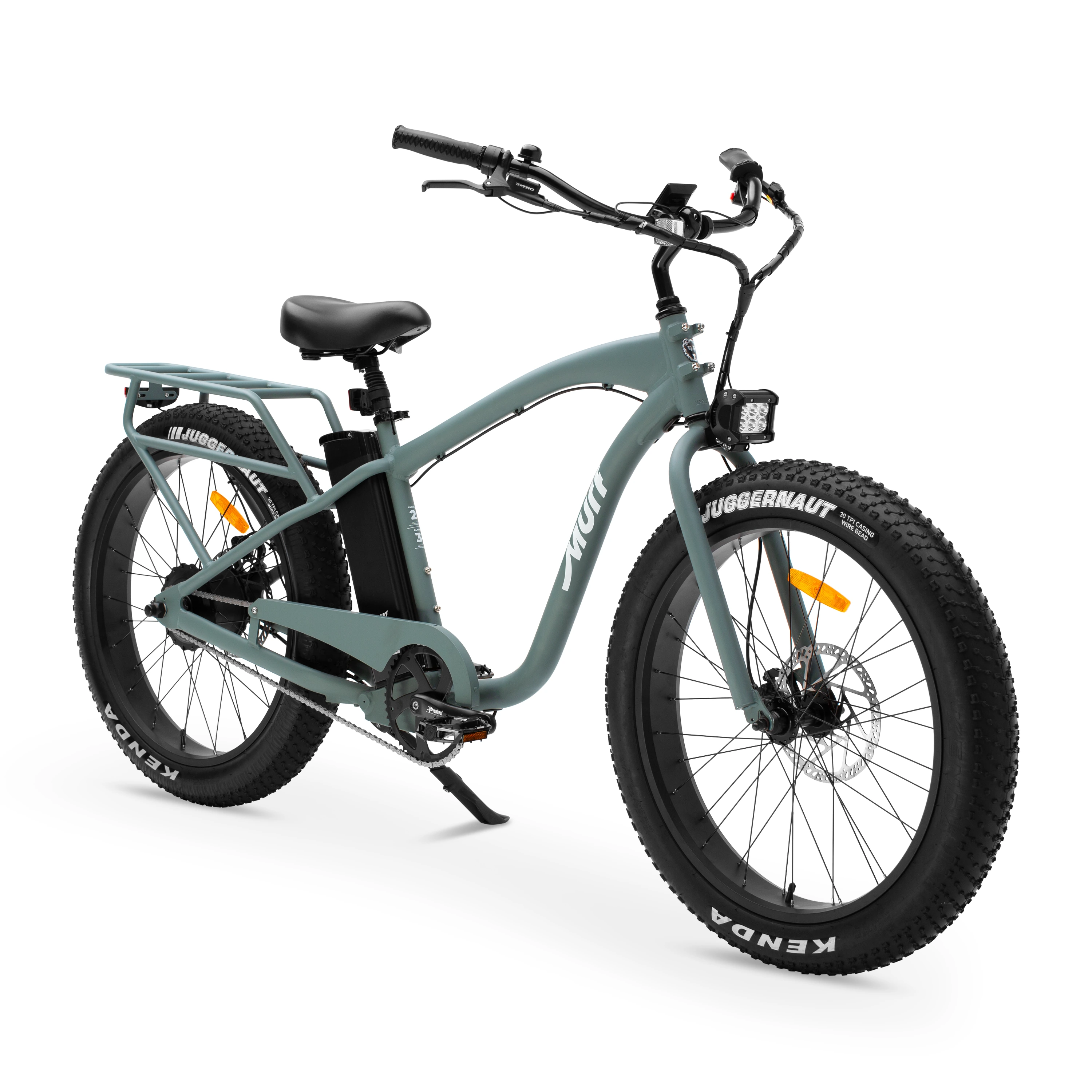
- The Magic Feature: Upright Ergonomics & Low Step-Thru. If swinging your leg over a high bar makes your hips ache, you’ll never ride the bike. You want sweeping handlebars that let your shoulders drop, an ultra-cushioned saddle, and a frame you can simply step right through.
- The Frame: Step-thru beach cruiser or relaxed compact fat tire that floats over cracked sidewalks and rail crossings.
- Curated Models to Inspect: Murf The Higgs ST, Murf The Gigi, Himiway D5 Step-Thru.

A $2,000 bike shouldn't give you $2,000 worth of anxiety.
ACT 2: THE CONCERNS — The Elephants in the Garage
Whenever someone hesitates before buying an e-bike, it’s almost never about the price. It’s about anxiety. Let’s tackle the two biggest worries head-on:
Concern #1: “What If Somebody Steals It?”
You’re dropping $1,500 to $2,500 on an e-bike. The fear of walking out of a coffee shop to find an empty bike rack is real.
Here is our 3-Layer Peace-of-Mind Armor:
- Ditch the Cable Lock (Seriously): Cable locks are made of braided wire that handheld bolt cutters can slice through in 15 seconds. Spend $60 on a hardened steel chain or heavy U-lock (like a Kryptonite Keeper). Lock through the frame and rear wheel to a fixed post. Thieves look for easy targets; a hardened chain makes them keep walking.
- The 60-Second Digital Paper Trail: The day your bike arrives, snap two photos on your phone: one of the serial number stamped under the bottom bracket, and one of you standing with the bike. Register it on Bike Index (it's 100% free). If it’s ever stolen, police and pawn shops across the country can run the serial number instantly.
-
The $8/Month Silver Bullet: Sundays Insurance:
Most homeowners or renters policies explicitly exclude electric vehicles or carry a $1,000 deductible with depreciation penalties.
That’s why we partner with Sundays Insurance. They offer dedicated e-bike coverage starting at around $8 a month. If someone takes an angle grinder to your lock at work, at the grocery store, or even cuts it off your car rack—you’re covered for full replacement value. For the cost of two iced coffees a month, you get to ride anywhere without the knot in your stomach.
👉 Read our full Sundays E-Bike Insurance Coverage Breakdown & FAQ →
Concern #2: “What If the Battery Dies or Something Breaks?”
- The Battery Life Reality: Quality e-bike batteries use automotive-grade lithium cells (LG, Samsung, or Panasonic). They are engineered for 600 to 800 full charge cycles. If you ride 20 miles three times a week, that battery will realistically last you 4 to 6 years before you notice any meaningful range drop.
- The Lone Star Heat Rule: Here in Texas, batteries don't hate the cold—they hate scorching heat. Never leave your battery locked in a closed car trunk during July, and let the battery rest in the shade for 15 minutes to cool down before plugging it in after a ride.
- No Proprietary Nightmares: We refuse to sell bikes with weird, closed-door proprietary parts. The chains, tires, brake pads, and derailleurs on our curated fleet are standard bicycle components. If you get a flat or need a brake tune, any neighborhood bike shop can fix it in an afternoon.

You handle the air and lube. Your local shop handles the heavy lifting.
ACT 3: EXPECTATION SETTINGS — The Honest Rules of the Road
Let’s set expectations so that from Day One, you ride with complete confidence.
1. Where Can You Legally Ride? (The Texas 3-Class Rule)
Under federal statute (15 U.S.C. § 2085) and Texas Transportation Code § 551.102, e-bikes are legally treated as bicycles—meaning you don't need a driver's license, vehicle registration, or state inspection. But they are divided into three classes:
| Class | Motor Assist Cap | Throttle Included? | Where It Rides Best |
|---|---|---|---|
| Class 1 | 20 MPH (Pedal Only) | No | Strict singletrack trails, national parks, greenways. |
| Class 2 | 20 MPH (Pedal or Throttle) | Yes (Thumb Throttle) | The Sweet Spot: City streets, bike lanes, paved greenways, and trail systems. |
| Class 3 | 28 MPH (Pedal Only) | Optional (caps at 20) | Road commutes, arterial streets, fast vehicle pace. |
Maverick’s Take: For 90% of riders, Class 2 is king. Having that thumb throttle lets you start instantly at uphill traffic lights without straining your knees, while remaining 100% legal on San Antonio’s extensive paved Howard W. Peak Greenway trails.
2. The Honest Range Math (Debunking the "70-Mile" Myth)
When a manufacturer advertises "70 to 80 Miles Per Charge," read the fine print: that test was done by a 110-pound rider on flat-as-glass pavement with zero wind in the lowest assist setting.
Here is the honest formula we use: Expect roughly 15 to 20 Watt-Hours (Wh) per real-world mile.
- A standard 720Wh battery will give you an honest 35 to 45 miles of spirited riding with hills, traffic, and throttle use.
- A massive 1,040Wh battery will give you 55 to 70 real-world miles.
- Bottom line: Match the battery to your actual round-trip commute, not an imaginary cross-country tour.
3. Maintenance: What You Do vs. What the Shop Does
Owning an e-bike isn't like maintaining a car. It takes about 5 minutes of care a month:
-
What You Do (Monthly, in your garage):
- Check tire pressure with a floor pump (proper PSI prevents pinch flats).
- Wipe the chain clean and apply dry bike lube.
- Keep the battery stored indoors at room temperature.
-
What Your Local Bike Shop Handles (Once or twice a year):
- Hydraulic brake bleeds and fresh pad installation.
- Spoke tensioning and wheel truing.
- Firmware/controller checkups.
You’re never alone in this. Pathfinder Pedal acts as your personal concierge—we provide unboxing assembly video walkthroughs, ship replacement parts directly under our 2-year manufacturer warranties, and connect you with local certified mobile mechanics.
🎯 The Final Takeaway: Ready to Ride?
Stop overthinking the spec sheets.
- Decide your mission: Commute, cargo, or cruise?
- Lock in your peace-of-mind stack: A heavy chain + Sundays Insurance.
- Pick a Class 2 ride and go reclaim your neighborhood.
Need a second pair of eyes on your choice?
Browse our curated collections below, or hit the chat button right here on the site. You’ll get a real human in San Antonio who actually rides these streets.
- Explore Commuter & City E-Bikes →
- Explore Cargo & Family Utility E-Bikes →
- Explore Cruiser & Comfort E-Bikes →


