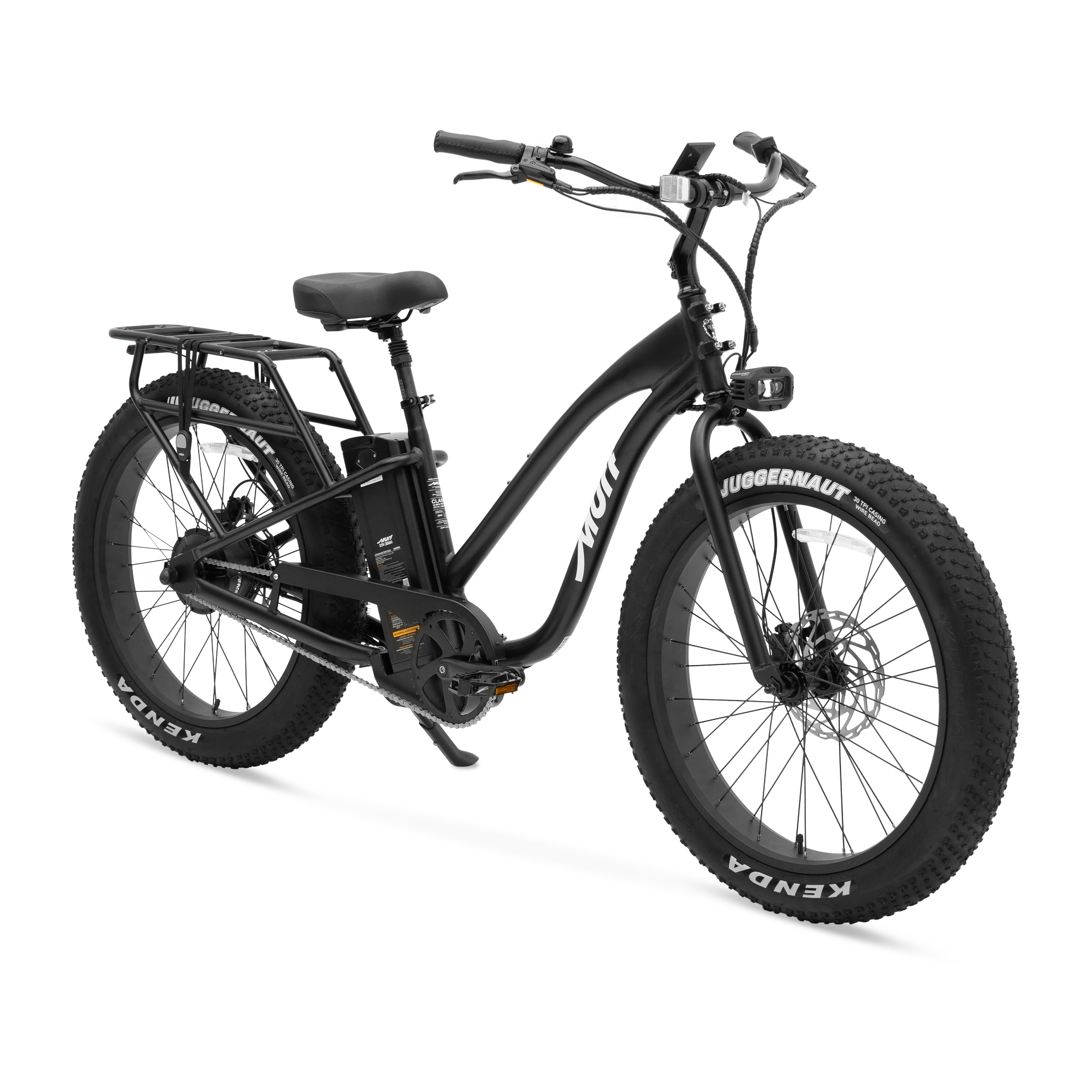
Same Bike. Two Frames. One Is Wrong for You.
By the Pathfinder Pedal Team
You're at a traffic light on Broadway. It's 91 degrees. There's a bag of H-E-B groceries bungeed to your rear rack and a Silverado idling two feet behind you.
The light goes green. You need to get on this bike and go — now.
If you're on a step-through frame, you step through the opening, sit down, and pedal. Done. If you're on a step-over, you swing your leg over a 20-inch bar while a bag of tortillas shifts your center of gravity and the guy in the truck is already on his horn.
That's the whole debate. Not speed. Not motor power. Not some spec you'll compare on a spreadsheet. It's how you get on the thing when it matters.
The Himiway D5 2.0 comes in both frames. Same 750W Bafang mid-drive. Same 48V battery. Same 60–80 mile range, depending on terrain, rider weight, and how much you lean on the throttle. Same price. The motor doesn't care which frame it's bolted to. Your knees might.

The "Women's Bike" Thing — Let's Kill That Now
Step-through frames have been stuck with the "women's bike" label since the 1950s, when the low bar was designed around skirts. That was 70 years ago. Skirts aren't the issue anymore. Knees are.
In the Netherlands — the country where more people commute by bike than anywhere else on Earth — over 70% of commuter bikes are step-through. Men, women, everyone. They don't call it a women's bike. They call it a bike. That's probably the right call.
So what does a step-through frame actually give you?
You stop faster. Pull up to a red light, plant both feet flat, stand there like a normal person. No bar to clear. No awkward lean-and-hope. If your rides involve more than five stops — lights, crosswalks, coffee shops, dog-walk pauses — this adds up quick.
Your joints don't have to audition. If your knees, hips, or lower back have started filing complaints, a 20-inch standover height isn't an inconvenience — it's a wall. Step-through frames skip the flexibility test entirely. That's the same reason e-bikes keep showing up in knee rehab research — less impact at the moments that matter most.
Loading cargo gets boring instead of acrobatic. Groceries, a pannier bag, a dog leash, a toddler seat — anything that makes your rear rack a no-fly zone for leg swings. Step-through geometry means you walk alongside the bike like a shopping cart. No vaulting. The cargo e-bike riders we wrote about figured this out fast.
Your wrists and back get a break. Step-through frames default to a more upright posture. If your primary goal is comfort — Saturday mornings at the Pearl or birding along Salado Creek — that posture is what turns a 90-minute ride from "I need to lie down" into "let's keep going."

When the Step-Over Earns Its Top Tube
A step-over frame — the diamond shape with the horizontal top tube — is the geometry you picture when someone says "bicycle." And there's an engineering reason it's been around for a century: that closed triangle is stiffer and lighter than an open frame. Physics, not tradition.
Here's where you actually feel it:
Washboard gravel at 18 mph. The step-over tracks straighter. Less handlebar wander, more predictable feedback through your hands. On the kind of terrain we covered in the 750W fat tire guide — sand, packed dirt, gravel shoulders — the stiffer frame gives you a real edge.
Steep descents. More rigidity means more confident braking. You trust the bike under you. On technical singletrack, that trust isn't abstract — it's the difference between committing to a line and second-guessing it.
Mounting points. The top tube gives you real estate for frame bags, water bottle cages, and tool rolls. If you tour long distances, that space matters. Not a dealbreaker, but good to know.
Here's where you don't feel it:
Paved greenways, city streets, and suburban sidewalks at 15–20 mph. Modern step-through frames use reinforced downtubes and head tube gussets that have closed the rigidity gap significantly. The D5 2.0 ST uses the same mid-drive, carries the same rider weight rating, and hits the same speeds as its step-over sibling. For 80% of riding scenarios, the stiffness difference is academic.
Honest version: if you ride hard off-road as your primary thing — not occasionally, but most rides — the step-over gives you an edge. If you ride paved paths and city streets, it doesn't.

The D5 2.0 Side-by-Side (Same Specs, Different Life)
We carry both. Here's why the comparison is clean:
| Spec | D5 2.0 Step-Over | D5 2.0 ST |
|---|---|---|
| Motor | 750W Bafang Mid-Drive | 750W Bafang Mid-Drive |
| Battery | 48V (Himiway proprietary) | 48V (Himiway proprietary) |
| Range | 60–80 miles | 60–80 miles |
| Frame | Diamond (traditional) | Low-entry step-through |
| Getting on | Leg swing over top tube | Step through and sit |
| Best for | Trail, gravel, aggressive terrain | Urban, commute, cargo, accessibility |
| Frame bag mounts | Yes (top tube) | No |
| Flat-foot stops | Depends on your height | Built into the design |
Every number matches. The only thing that changes is how Tuesday morning feels when you're half-awake and the coffee hasn't kicked in yet.
Five Questions. That's All You Need.

Forget pros-and-cons lists. Answer these:
1. Can you swing your leg over a 20-inch bar without thinking about it? If you hesitated — even a little — the step-through removes the question. No flexibility audition required.
2. Do you stop more than five times per ride? Traffic lights, school zones, the taco truck on Flores, your neighbor who wants to talk. If your rides are stop-and-go, the step-through's flat-foot stability saves energy and dignity.
3. Is off-road your primary use — not occasional, but most rides? If aggressive trail riding is the main event, the step-over's frame stiffness gives you better tracking. Check the terrain breakdown in our fat tire guide for the full picture.
4. Have your knees, hips, or balance started having opinions? If yes, the step-through isn't a compromise — it's the feature. The research on e-bikes and joint health backs this up: lower-impact mounting reduces strain on exactly the joints that make riders quit.
5. Are you loading cargo, kids, or pets? If you regularly wrestle a rear rack, pannier, or child seat, the step-through gives you walk-alongside access. No gymnastics.
The math: If you said yes to 1, 2, 4, or 5 — step-through. If question 3 is your primary use — step-over. Most urban and suburban riders are step-through riders who don't know it yet.

The Pairing Most Articles Miss
Step-through frames and torque sensors are a natural match, and almost nobody talks about it.
A torque sensor reads how hard you push the pedals and gives you proportional assist — gentle pressure, gentle boost. A cadence sensor just detects that you're pedaling and dumps a fixed amount of power regardless. On a step-through frame — where you're optimizing for smooth starts from dead stops at intersections, parking lots, and greenway merge points — the torque sensor gives you controlled acceleration instead of a lurch that makes you grab the brakes.
The D5 2.0 runs a mid-drive, which pairs better with pedal input than a hub motor. If you're riding Class 2 with throttle, you've got both options: thumb throttle for zero-effort starts, torque-based PAS for the rides where you actually want exercise.
The Questions Everyone Asks
"Is a step-through e-bike less sturdy?" No. Modern frames use reinforced downtubes and head tube gussets. The D5 2.0 ST carries the same rider weight limit as the step-over. Same load rating, same frame warranty.
"Do step-through e-bikes go slower?" No. Same motor, same battery, same controller, same top speed. Frame shape affects how the bike handles, not how fast it goes.
"Isn't a step-through bike just for women?" No. Legacy label. The Dutch settled this decades ago. Every major manufacturer markets step-through frames as unisex. In 2026, the only people who still think it's a women's bike are the ones who haven't ridden one.
"Which frame handles heavier riders better?" Both carry the same weight ratings on the D5 2.0 platform. Step-through is generally easier to mount at higher body weights — less leg lift, lower center of gravity at the mounting point.
"Can I ride a step-through off-road?" Yes. Same tires, same suspension, same motor. The step-over has a slight stiffness advantage on aggressive terrain — but for fire roads, packed trails, and light gravel, the ST handles it fine.
Our Take
We carry both frames because the right answer depends on your knees, not your ego.
If you want to see both versions side by side — or check out the Higgs ST as a step-through urban cruiser — browse our full Himiway collection or reach out with your route, your terrain, and your budget. That's what we're here for.
We don't push frames. We match them.
Sources: Himiway manufacturer specifications (vendor profile 70.20), Netherlands cycling adoption data (Dutch Cyclists' Union / Fietsersbond), cycling injury statistics (Journal of Transport & Health, trauma registry analyses 2016-2020). Frame engineering data from independent cycling industry research.
Pathfinder Pedal — A Concentric Industries LLC Company Phone: +1 833 716-7886 | Email: Hours: Monday–Friday: 9 AM – 5 PM | Saturday: 10 AM – 7 PM